What
Is It Like to Do Math Research with Frontier Agents?
TL;DR: I proved novel math results using frontier
models.
The experience made one thing clear: regardless of
domain, if you have the ability to take big problems and break them
down well, these models are a huge lever to compound your abilities. If
you are a low-level execution monkey without the ability to see the
bigger picture, these models will replace you.
In the last 8 months, the way software is developed has changed
completely. As someone who has written software almost every day for a
decade, I have a deep touch and feel for the ways in which it has
changed. In some ways, it matches (or even exceeds) the hype I see on
Twitter, but in other ways it falls short.
Frontier model labs have been teasing that the same step change is
here for math research — multiple labs have won IMO gold medals with
their models and, as of a month ago, OpenAI announced that GPT 5.5 Pro
contributed
a new result on a core, well-studied problem. In the same way that
you can’t develop a touch and feel for how software development has
changed without using the tools to do software development, I didn’t
know what to make of these math results.
The trouble is, assessing a model’s math capabilities (and not just
math recall) is far more challenging than assessing its coding
capabilities — any nontrivial codebase doing anything interesting is
probably novel in some way, and you can readily see the agent’s ability
to work in-context. The same is not true with math — (almost) everyone’s
using the same set of standard definitions, so unless you’re working on
the frontier of mathematics, the question you’re posing is likely in a
paper somewhere and, by extension, in the model’s training data; the
model could simply be recalling the answer to your question rather than
developing a novel line of reasoning.
So, to do a test for myself, I decided to work with the models on an
open problem in an incredibly niche area of graph theory. I am not a
mathematician, but I do have a PhD in CS, a decent math background
including graduate-level
graph theory, and I have published papers on graph search algorithms that, at
their core, heavily leverage graph transformations. I think this is
the only area of mathematics where I have sufficient background to
meaningfully comment or contribute.
A Graph Theory Adventure
The setup
A few days ago, I stumbled across the 2022 paper Conditional
Fractional Matching Preclusion for Burnt Pancake Graphs and Pancake-Like
Graphs. In it, the authors explore a niche
corner of graph theory:
In loose terms, matching preclusion asks how much damage a network
can sustain before it loses a particular global pairing structure.
- burnt pancake graphs; a special case of pancake graphs, i.e., graphs formed by
different ways you can flip stacks of pancakes that have been “burnt” on
one side to mark direction (famously, Bill Gates’ only paper was on an
algorithm for Pancake Sorting)
- a special setup for matching preclusion, i.e., the minimum number of
vertex or edge deletions needed to preclude a special matching
structure
The authors perform an inductive proof of the minimal preclusion edit
for burnt pancake graphs, using a computer program (which, despite
leveraging clever techniques like dynamic programming, still took almost
a day to run) to check the base cases and then a constructive proof for
the inductive case. The authors left the same problem for the standard
“unburnt” variety of pancake graphs as an open problem, remarking that
their approach of enumerating the base cases on a large set of graphs
would likely require a computer cluster.
This is an extremely narrow problem, but that is precisely what made
it useful as a test. It has a precise target, a published solution to a
closely related problem, and small cases that can be checked
computationally. At the same time, proving the result for every  requires a general
argument; simply searching more cases cannot finish the job. If the
models could produce that argument, it would be much stronger evidence
of novel reasoning than success on a problem that might have appeared in
their training data.
requires a general
argument; simply searching more cases cannot finish the job. If the
models could produce that argument, it would be much stronger evidence
of novel reasoning than success on a problem that might have appeared in
their training data.
I did a literature review (with Codex) and found no real follow-up
work for the unburnt formulation, only adjacent problems. Because I
understood this problem and the authors’ solution, and because no
solution appears anywhere online, this felt like a perfect place to
work.
The human insight
By definition, pancake graphs of
stack size  (denoted ) have degree
  for every vertex: one neighbor for each of the
places to insert the
spatula to do a legal flip. As discussed in the 2022 paper, this
matching preclusion problem is not allowed to admit degenerate solutions
(you aren’t allowed to just isolate a lone vertex), and so one way to
construct a preclusion is to isolate a path
for every vertex: one neighbor for each of the
places to insert the
spatula to do a legal flip. As discussed in the 2022 paper, this
matching preclusion problem is not allowed to admit degenerate solutions
(you aren’t allowed to just isolate a lone vertex), and so one way to
construct a preclusion is to isolate a path  , creating two leaves
  and
and  hanging off a shared vertex
  . Thus, when deleting , two vertices are stranded at once
rather than a single vertex. Using the fact that all vertices have a
known degree , we know that to construct this path you have to
delete all the other edges from and , leaving only their edges to (i.e., by performing
. Thus, when deleting , two vertices are stranded at once
rather than a single vertex. Using the fact that all vertices have a
known degree , we know that to construct this path you have to
delete all the other edges from and , leaving only their edges to (i.e., by performing  deletions).
This line of reasoning provides an upper bound on the size
of the fault set, but it felt clear to me that this was also
required for a minimal construction of the preclusion. As the
2022 paper authors did, you can just brute-force a reasonably sized base
case, but it wasn’t clear to me how to attack the inductive step to
prove this was minimal.
Machine magic
If I had to prove this myself, I’d:
- draw a bunch of pictures of
 and try to construct example
fault sets that were cheaper, in order to understand the
substructure
and try to construct example
fault sets that were cheaper, in order to understand the
substructure
- read other adjacent literature to understand their lines of attack
and proof techniques
- talk to (or call) a friend for ideation
- reread my graph theory textbook
But I did none of that. Instead, I gave the line of reasoning above,
plus the 2022 paper, to Codex. Codex only has access to GPT 5.5 Low to
Extra High, not Pro, so I asked Codex’s 5.5 xhigh to use the Chrome
connector to spin up five 5.5 Pro sessions, attack the problem in
parallel using this intuition as a guide from five different angles, and
have the Codex xhigh session itself ultimately assemble these ChatGPT
results into a coherent final proof.
To be honest, I expected muddled sophistry, but what came out was an
interesting (and correct!) construction of a proof. It contained two key
ideas:
- focusing the accounting on creating the left-behind “witness set” of
isolated vertices, not the fault set as done in the 2022 paper
- constructing a cost function
 that it used to perform the
core accounting of costs for this witness set
that it used to perform the
core accounting of costs for this witness set
These reframings should be credited to ChatGPT, not me. My intuition
that  was minimal turned out to be correct, and my
description of the isolated and may have suggested that the problem could be
sliced this way. But it did not occur to me to make the witness set the
central object of the proof or to construct around it.
was minimal turned out to be correct, and my
description of the isolated and may have suggested that the problem could be
sliced this way. But it did not occur to me to make the witness set the
central object of the proof or to construct around it.
Of course, a clever-looking proof from a language model is cheap; the
difficult part is determining whether it is actually correct. I checked
the result in layers. First, the Codex session wrote a Python program
that enumerated every  witness set and confirmed the base case
computationally. Next, I iterated on the definitions until the general
argument was clear enough for me to audit directly. Finally, I gave the
proof to fresh instances of GPT 5.5 Pro, Gemini 3.1 Pro, and Fable 5 and
asked them to search adversarially for gaps and counterexamples.
witness set and confirmed the base case
computationally. Next, I iterated on the definitions until the general
argument was clear enough for me to audit directly. Finally, I gave the
proof to fresh instances of GPT 5.5 Pro, Gemini 3.1 Pro, and Fable 5 and
asked them to search adversarially for gaps and counterexamples.
Only after that process did I trust the result. The original output
had been dense with jargon, but beneath it was a surprisingly cogent
argument. We eventually arrived at the proof as written in the paper. I
think its use of witness sets is elegant enough — and sufficiently
different from the 2022 paper’s approach — to be worth publishing.
A second surprise:
presentation
I’ve never been happy with the expository writing quality of LLMs. I
think I write pretty well, and I like to think my writing is clear,
direct, and information-dense while forwarding a new perspective. I feel
that LLM writing is almost always the opposite. I semi-regularly write technical blog posts, and I’ve tried to
give LLMs a solid, coherent bullet-point argument structure with the
sole task of turning it into fluent prose, and every time I’ve abandoned
trying to even salvage its output in favor of writing it myself.
I planned to write up the proofs myself by hand, but as an exercise I
asked Fable 5 to take the core proof I’d developed, written in a creole
of LaTeX and Markdown, and turn it into the paper. Shockingly, I
actually felt its presentation was quite good. I think some of this can
be attributed to the fact that Fable is a better writer than other
models (GPT 5.5 writes like a redditor with a personality disorder), but
I think a lot has to do with the structured nature of mathematics
papers. Unlike CS papers, math papers start with a short, technical
introduction / related work hybrid section, provide an overview of the
main results, and then immediately dive into a series of proofs. In my
opinion, Fable did an excellent job capturing this structure and
provided a phenomenal first draft that only required a bit of expository
polishing throughout.
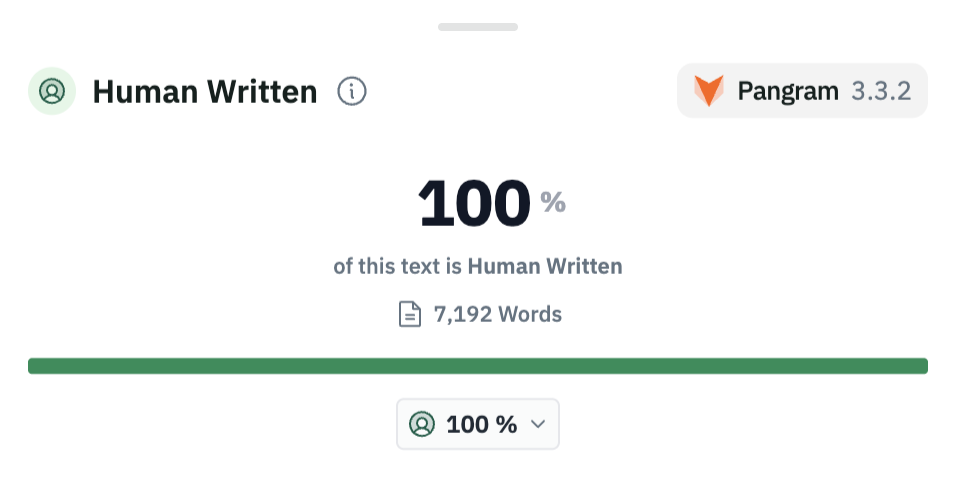
After several rounds of polishing, Panagram certified the final paper
as 100% human-written.
My Takeaways
These tools really are general purpose levers for people who see the
bigger picture and have the clarity of thought to break things down
cleanly.
In undergrad, I distinctly remember doing problem sets where, given a
big problem, I had a deep intuition for how to break it down into
subproblems, but I would sometimes struggle with recalling all the
different low-level proof tactics. Because of this, I worked alongside
another student who had trouble breaking the big problems down correctly
but had phenomenal low-level proof abilities. I would break the problem
down into subproblems and give a sketch of why I thought this was a
reasonable high-level trajectory; then he’d take the lead on doing the
low-level proof. We’d ultimately succeed or fail on the proof, and these
outcomes would better inform my intuition about which subproblem
formulation to try next.
For people who do math research using my high-level intuition style
of approach, these tools are an enormous lever. Not only are you no
longer bottlenecked on your low-level proof ability, your intuitions can
get sharper, faster. The workflow above is essentially a GRPO
loop for your own mathematical intuitions; it lets you take far more
shots on goal, as well as do a post-game analysis to get a better touch
and feel for why a shot did or did not work across multiple
different agent efforts, at the speed you can read and type.
People who do math research using exceptional low-level proof-tactic
abilities will see only modest value from these tools. They will likely
get better by studying the agents the same way top Go players got better
after learning from AlphaGo, but their productivity will likely remain
roughly the same.
If you’re a software engineer, these conclusions should sound quite
familiar: if you can do system design, coding agents are huge levers; if
you are merely an implementation monkey, you’re getting cooked. A
K-shaped future awaits.