 distinct pancakes: one vertex per
permutation. Two stacks are adjacent when a single flip turns one into
the other, where a flip means sliding a spatula under the top
distinct pancakes: one vertex per
permutation. Two stacks are adjacent when a single flip turns one into
the other, where a flip means sliding a spatula under the top  pancakes and turning that block
over.
pancakes and turning that block
over.A pancake graph has one vertex for every way to stack distinct pancakes: one vertex per
permutation. Two stacks are adjacent when a single flip turns one into
the other, where a flip means sliding a spatula under the top pancakes and turning that block
over.
Formally, let  be the symmetric group on symbols. For
  , the
prefix reversal
, the
prefix reversal  flips the first
  entries:

The pancake graph is the Cayley graph

So  has
has  vertices, and each vertex has one neighbor per
available flip: degree
vertices, and each vertex has one neighbor per
available flip: degree  for
for  .
.
| Stack size | Vertices | Degree | Shape |
|---|---|---|---|
 |
 |
 |
A single vertex |
 |
 |
|
A single edge |
 |
 |
|
A 6-cycle |
 |
 |
 |
A 3-regular graph |
In  , the identity stack
  has three neighbors, one
per flip:
has three neighbors, one
per flip:

The labels record which flip was used; the graph itself has just one undirected edge between each such pair.
 : One Flip, One Edge
For two pancakes there are two stacks,  and
and  , and one flip,
  . So is a single edge.

 : A Hexagon
For three pancakes the only flips are and  , so every vertex has degree
two, and a connected 2-regular graph is a cycle. The six stacks form a
hexagon, with the two flips alternating around it:
, so every vertex has degree
two, and a connected 2-regular graph is a cycle. The six stacks form a
hexagon, with the two flips alternating around it:

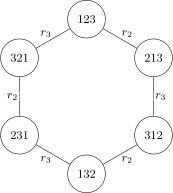
This is the best small example to keep in your head.
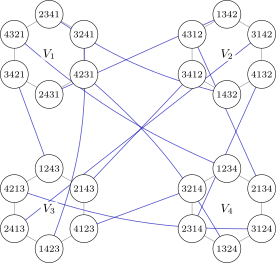
: The Full Graph has  vertices. Three flips are
available (, ,
vertices. Three flips are
available (, ,  ), so the graph is 3-regular, with

edges. Here is all of it. Gray edges are and flips; blue edges are flips. The four hexagons
are not an accident of the layout — the next section explains them.
Group the stacks by the pancake on the bottom:

The flips  never touch the bottom pancake, so inside each
 they build a copy of
  . Only the full flip
  moves the bottom pancake.
It pairs each stack with its complete reversal, so the edges form a perfect
matching on , and every matching edge joins two different
copies (a stack’s top and bottom pancakes differ).
moves the bottom pancake.
It pairs each stack with its complete reversal, so the edges form a perfect
matching on , and every matching edge joins two different
copies (a stack’s top and bottom pancakes differ).
In short: is copies of , glued together by a perfect
matching.
This is exactly what the drawing above shows. The four hexagons are the
copies of — the stacks sharing a bottom pancake — and the
blue matching glues them together.
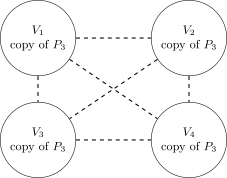
The glue also spreads out evenly. An edge joins to  exactly when a stack has
 on the bottom and
  on top, and there are
  ways to fill in the middle. So every pair of
copies is joined by exactly matching edges, and collapsing each copy to a
single node turns into the complete graph
ways to fill in the middle. So every pair of
copies is joined by exactly matching edges, and collapsing each copy to a
single node turns into the complete graph  .
.
For : four copies of , with  matching edges behind each
dashed line.
matching edges behind each
dashed line.
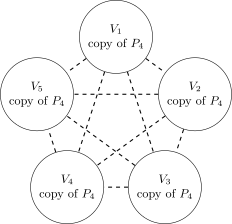
For  : five copies of , with
  matching edges per pair.
For  : six copies of , with
  matching edges per pair.
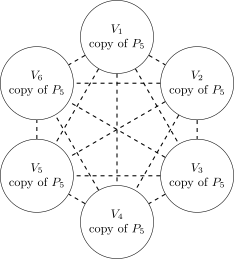
This decomposition is the main reason pancake graphs are pleasant to
prove things about: a question about usually reduces to the same question inside
copies of , plus a controlled accounting of
the matching edges. The companion note on Berge-Tutte obstructions and
recursive cost shows that accounting in action.