 with no fractional perfect
matching but also no isolated vertex. The answer, for
with no fractional perfect
matching but also no isolated vertex. The answer, for  , is
, isThis note is a visual companion to the pancake graph
preprint. The paper computes the conditional fractional strong
matching preclusion number of the pancake graphs: the smallest number of
deleted vertices and edges that leaves with no fractional perfect
matching but also no isolated vertex. The answer, for , is

together with a complete list of the fault sets achieving it.
This note is not a replacement for the proof. Its goal is to show the
mechanism: any fault set that succeeds must create a Berge-Tutte
obstruction, every obstruction comes with a local bill, and the
recursive structure of makes almost every bill exceed  .
.
For background on the recursive decomposition, see Pancake Graphs and their recursive structure.
A graph has a fractional perfect matching exactly when no vertex set
 leaves more than
  isolated vertices after its
removal. That is the fractional Berge-Tutte criterion. So if a fault set
isolated vertices after its
removal. That is the fractional Berge-Tutte criterion. So if a fault set
 destroys every fractional
perfect matching of
destroys every fractional
perfect matching of  , some separator must witness the failure:

Let  be the isolated vertices of
  . Because the fault set
is conditional,
. Because the fault set
is conditional,  has no isolated vertices, so the vertices of become isolated only once is removed; in particular
  .
.
In the picture below, red vertices are the isolated set , blue vertices are the separator , gray vertices are the rest of the
graph, and the short red stubs mark fault edges that were removed.
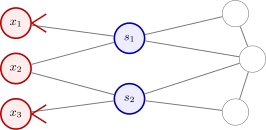
The key move in the paper is to stop thinking about directly and instead charge to its witness .
For a vertex set , define its isoperimetric cost

where  counts the edges inside and
  is the set of outside vertices
with a neighbor in . The claim: any conditional fault set with
witness contains at least
is the set of outside vertices
with a neighbor in . The claim: any conditional fault set with
witness contains at least  faults.
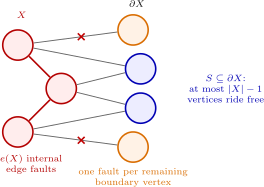
The count is direct. Every edge inside must be a fault, because its endpoints
survive yet end up isolated. Every boundary vertex must also be dealt
with: either it is deleted, or its edges into are — unless it belongs to , in which case the separator handles it
for free. The strict inequality  caps the free rides at
  . Adding it up, contains at least
  faults.
For pancake graphs, write  for this cost in . The whole
matching-preclusion problem now reduces to a single question: show that
for this cost in . The whole
matching-preclusion problem now reduces to a single question: show that
 for every candidate witness .
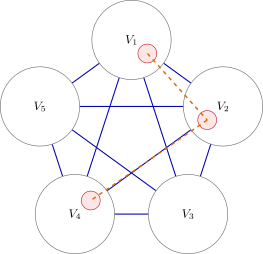
Group the vertices of by last symbol:

Each  is a copy of
  , and the full reversal
  joins the copies by a
perfect matching. Write
joins the copies by a
perfect matching. Write  for the piece of the
witness inside copy
for the piece of the
witness inside copy  . The bill then decomposes exactly:

| Term | What it counts |
|---|---|
 |
The internal bill for the piece of inside copy |
 |
Matching edges with both endpoints in |
 |
Mates of that land outside and its internal boundary, creating new
boundary |
 |
The global  from the definition of from the definition of  |
Every term is nonnegative. This identity is the proof engine: a
witness pays a bill inside every copy it touches, plus a toll each time
the full-reversal matching fails to line up with .
The main theorem says that, for ,

The lower bound is proved by induction on  . Here is the shape of the argument at
 . The pictures are schematic: they
show only the parts of a witness that matter to the accounting.
. The pictures are schematic: they
show only the parts of a witness that matter to the accounting.
 : the base case costs six
The recursion bottoms out at , standing on an exhaustive table for  : the paper enumerates all
 vertex subsets of the 24-vertex graph and records the minimum of
 at each size. That is a few
seconds of edge counting — no linear programming, no fault-set
enumeration.
at each size. That is a few
seconds of edge counting — no linear programming, no fault-set
enumeration.
The case is then a short case analysis. If sits inside a single copy, every mate
leaves the copy, and the identity collapses to  , which
the table bounds below by
, which
the table bounds below by  . If touches three or more copies, the per-copy bills
alone give
. If touches three or more copies, the per-copy bills
alone give  . Witnesses split across exactly two copies are
where the girth enters: has no triangles and no 4-cycles, and that rules
out every two-copy configuration cheaper than .
. Witnesses split across exactly two copies are
where the girth enters: has no triangles and no 4-cycles, and that rules
out every two-copy configuration cheaper than .
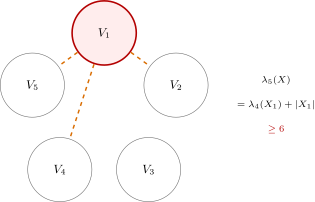
 : the same shape costs
eight
: the same shape costs
eightWith the  bound in hand, the induction step is almost
mechanical. A witness inside a single copy carries the old bill of at least , and its mates under
bound in hand, the induction step is almost
mechanical. A witness inside a single copy carries the old bill of at least , and its mates under  land in other copies as
fresh boundary — at least
land in other copies as
fresh boundary — at least  more. Total:
  . The
other shapes run the same ledger and also land at or above
. The
other shapes run the same ledger and also land at or above  .
.
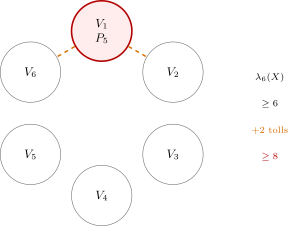
This is the inductive picture: a witness that was barely affordable one level down becomes exactly expensive enough one level up.
 : only close pairs stay
tight
: only close pairs stay
tightBy the accounting is rigid. A close pair — two
vertices that are adjacent or share a common neighbor — hits the target
 exactly. Anything more spread out pays a separate
bill in each occupied copy plus matching tolls, and overshoots.
exactly. Anything more spread out pays a separate
bill in each occupied copy plus matching tolls, and overshoots.
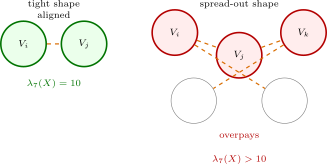
The pattern in general: the recursive identity keeps adding nonnegative tolls, and the only witnesses that never overpay are pairs of vertices at distance at most two.
The equality case has one concrete shape. Take an induced path  –
– –
– . The witness is
  , the separator is
  , and the boundary to pay is

Because has no triangles and no 4-cycles, and are nonadjacent, is their only common neighbor, and
every  has exactly one edge back to
  . So
. So  ,
and the optimal fault sets pay each boundary vertex exactly once: delete
either
,
and the optimal fault sets pay each boundary vertex exactly once: delete
either  itself or its one edge toward . Mixing vertex and edge payments
freely gives the complete list of optimal sets.
itself or its one edge toward . Mixing vertex and edge payments
freely gives the complete list of optimal sets.
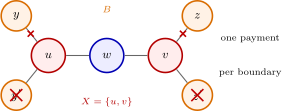
That is the whole classification: the witness is as small as possible, the separator is the forced common neighbor, and the boundary is paid with no slack.
Every conditional fault set has a witness , and

The first inequality is the local bill; the second is the recursive
ledger. Equality forces to be a close pair with each boundary vertex paid
exactly once — precisely the fault sets above.