Investors are betting big on robotics — over 6B in Q1 2026. But that begs the question: who ends up capturing real, long-term durable value?
I think the LLM space is a good surrogate for interrogating this question.
In the LLM space, “the model is the product” was the party line until very recently.
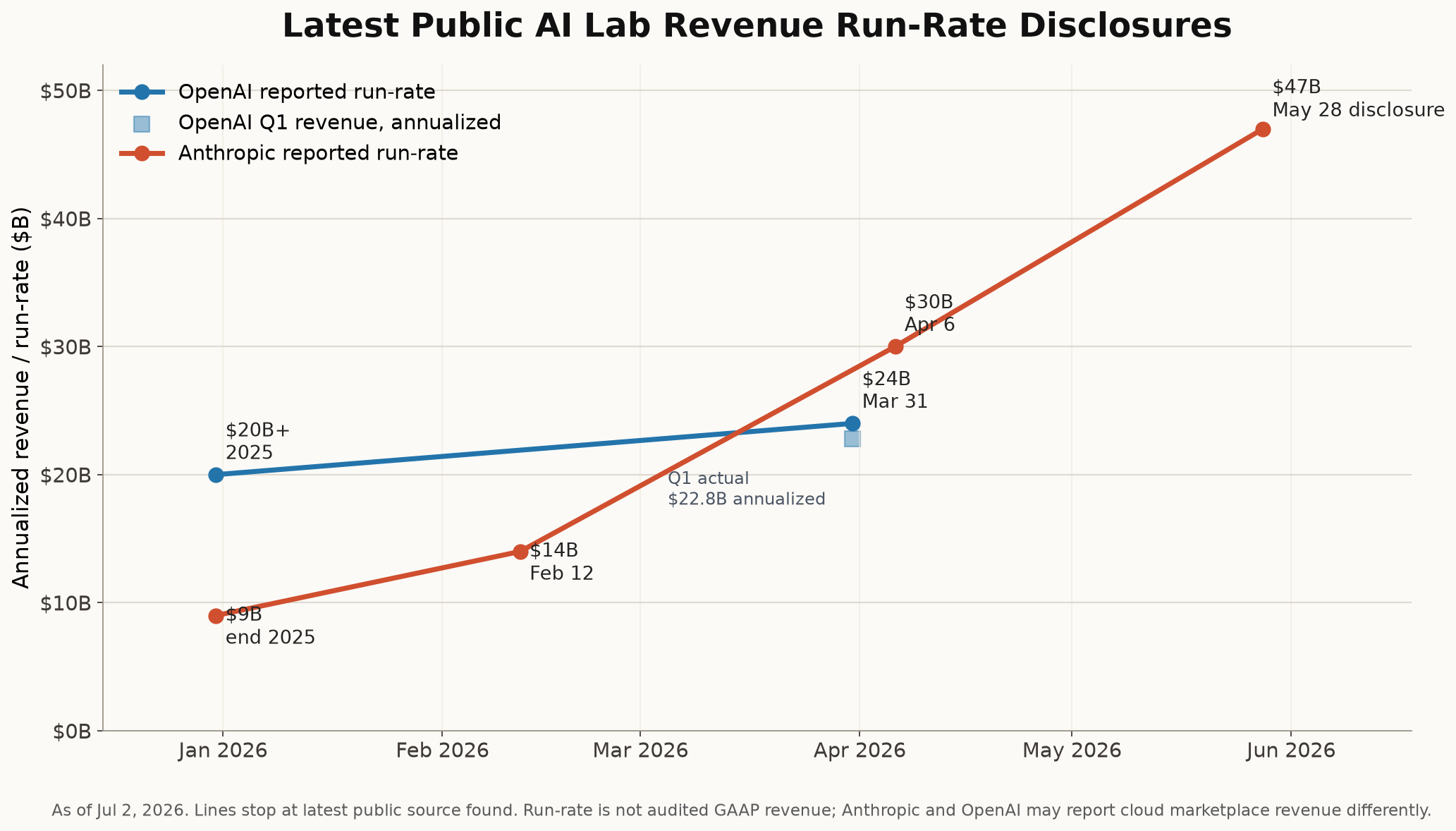
OpenAI and Anthropic are approaching trillion-dollar valuations. These valuations are no longer pure plays; they are driven by the explosive growth in revenue from selling tokens that come from their frontier models.
Unfortunately, “the model is the product” has a fatal flaw: IP theft. The very tokens that are being sold at scale are also being used as training targets for fast-follower Chinese open-source models. These models (and the Chinese labs that train them) turn around and sell marginally worse model capabilities for a tiny fraction of the cost.
Consequently, the American big labs have started to double down on deployment efforts — beyond the API, OpenAI and Anthropic have started developing entire walled-garden development ecosystems that wrap their models. The most advanced of these verticals is coding agents; both offer TUIs and now macOS-native GUIs, each with vendor-locked MCPs for integrations like Gmail, Google Calendar, Google Docs, Notion, Slack, and other commonly used tools.
They have also started Deployment Companies: OpenAI launched the OpenAI Deployment Company with TPG, Bain Capital, Bain & Company, McKinsey, Capgemini, and others, while Anthropic announced a new enterprise AI services company with Blackstone, Hellman & Friedman, Goldman Sachs, and a broader consortium of alternative asset managers.
Ultimately, these approaches to capturing value share a common thread: they are transitioning from selling the technology to selling services powered by the technology.
Like with LLMs, I suspect “selling intelligence” via General Policies will be a failed business model, and the only real value capture will be:
Core to an LLM’s value prop is its ability to work intelligently with arbitrary text and code. Even if you just wanted to build an LLM with deep expertise in a very specific domain (e.g. Toyota repair manuals), it greatly benefits from all the same background world knowledge that makes for a good LLM.
This is far less obviously true for robot policies. Do some long-horizon tasks like “clean the kitchen” need world knowledge? Absolutely yes. But does an industrial laundry-folding robot actually benefit from knowing how to drive a tractor? Does a paint-spraying robot or warehouse-picking robot actually benefit from knowing how to make a bed or where to put away the butter? No.1 There are plenty of economically useful tasks for which you do not need the most general possible policy and, worse, for which a single General Policy makes the wrong kind of trade-offs (e.g. knowledge capacity vs reactivity).
A direct consequence of robot policies being spikier than LLMs is that policies are easier to distill.
A business owner only cares about a robot’s performance in their facility. A homeowner only cares about a robot’s performance in their house. A systems integrator only cares that their platform is able to perform the task they are selling to customers. Any one of these actors need only record state-action pairs sent to the General Policy, and they have a distillation dataset they can use to train (or, more likely, fine-tune) their own model.
Open models suitable for fine-tuning will continue to exist. With the current open LLM paradigm, there’s good reason for moneyed interests to ensure open models stay competitive and new competitors emerge. For example: - Nvidia wants more labs to, in turn, buy more of its GPUs - XDOF wants more labs to, in turn, buy more of its data - Amazon (or anyone with serious human labor infra) wants open alternatives to hobble the pricing power of general policy labs
The TAM for robotics at large is huge. But only a small portion goes to consumers; much of that TAM is in the industrial sector.
Of that TAM in the industrial sector, only a fraction requires the kind of long-horizon planning and general world knowledge you need out of frontier General Policies; by design, business operations are engineered to limit the amount of judgment and decision-making left to labor.
As a consequence, deployment companies will not differentiate on “my model is smarter”; they will differentiate on holistic value-add to the business, competing on things like cost, throughput, and reliability.
This fact is why I think robot policy benchmarking (e.g. RoboArena, RLBench) provides little useful signal. LLM benchmarks like LLMArena can be (and were) gamed with surface-level tricks like generating longer or more upbeat responses, but there is still at least some signal – the underlying model has to know a decent bit about many possible topics, and this is core to the value prop for LLMs. This is not the case for robot policies: human-in-the-loop DAgger can push a policy to multiple nines for a given task, but that performance tells you almost nothing about its ability to perform similar tasks, and it’s not even clear whether the model needs to push nines on the given target task to make it a good general-purpose robotics model. For example, a qualitatively “better” base model could quantitatively perform worse at any given task; however, because it maintains the plasticity to be easily fine-tuned to extreme performance on downstream tasks, it is clearly “better” for downstream applications.↩︎