In this tutorial, we implement the transformer from a conceptual
description to an actual code implementation.
Creating embeddings
A transformer operates over a sequence of embeddings, each of
dimension  , often with positional information already added.
A good tokenization should maximize the unconditional entropy of tokens
in a sequence. The reason for this can be seen in the extreme: imagine a
tokenization where, 70% of the time, the unconditionally correct token
to predict was some special token
, often with positional information already added.
A good tokenization should maximize the unconditional entropy of tokens
in a sequence. The reason for this can be seen in the extreme: imagine a
tokenization where, 70% of the time, the unconditionally correct token
to predict was some special token  ; there would be far less signal pushing your
model to learn the conditional distribution rather than fit the
unconditional distribution.
; there would be far less signal pushing your
model to learn the conditional distribution rather than fit the
unconditional distribution.
The transformer is fundamentally a residual network atop the input
embeddings. The residual is computed by performing the following
flow:
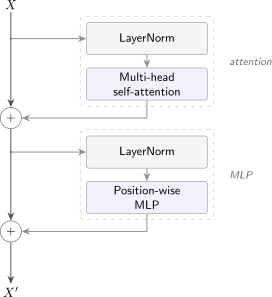
Below explains the blocks in more detail.
LayerNorm
LayerNorm normalizes each embedding vector independently so that the
statistics across its dimensions are well behaved. Specifically, it
transforms the vector so that its values have a mean of 0 and a standard deviation
of 1.
Multi-Head Self-Attention
Self-attention works by linearly projecting each input embedding (of
dimension ) in the sequence into query  , key
, key  , and value
  spaces. The attention layer computes how similar
each query is to each key (this is a quadratic operation, which is why
standard attention is quadratic), producing a square “similarity”
matrix. This similarity matrix is then masked (e.g., using causal
masking in LLMs), and a softmax distribution is computed over these
similarities for each embedding (i.e., over the second dimension of the
attention matrix). This resulting attention distribution determines the
weighting of how values from the value projection are combined to form
the attention output.
spaces. The attention layer computes how similar
each query is to each key (this is a quadratic operation, which is why
standard attention is quadratic), producing a square “similarity”
matrix. This similarity matrix is then masked (e.g., using causal
masking in LLMs), and a softmax distribution is computed over these
similarities for each embedding (i.e., over the second dimension of the
attention matrix). This resulting attention distribution determines the
weighting of how values from the value projection are combined to form
the attention output.
The above describes how single-head attention works. For multi-head
attention with  distinct heads, each head projects the input
embedding from dimension down to
distinct heads, each head projects the input
embedding from dimension down to  and performs attention in
  space. The results of the
attention heads are then concatenated into a vector of dimension and mixed with a learned linear output
projection before being added back to the residual stream.
space. The results of the
attention heads are then concatenated into a vector of dimension and mixed with a learned linear output
projection before being added back to the residual stream.
Position-wise MLP
The position-wise MLP is a hidden layer MLP (typically with a hidden
size of  ) run on each embedding vector independently.
Below is a reference implementation of the transformer in
PyTorch:
import torch

import torch.nn as nn

class MyTransformer(nn.Module):

    def __init__(self, D_model : int, num_heads : int):
        super().__init__()
        self.D_model = D_model
        self.num_heads = num_heads
        self.D_head = D_model // num_heads
        assert D_model % num_heads == 0, f"D_model ({D_model}) needs to be evenly divisible by the number of heads ({num_heads})"

        # LayerNorm
        self.attention_layer_norm = nn.LayerNorm(D_model)
        self.mlp_layer_norm = nn.LayerNorm(D_model)

        # Attention stream projections
        self.kqv_projection = nn.Linear(D_model, 3 * D_model)
        self.output_mixer_projection = nn.Linear(D_model, D_model)

        # Embedding MLP projections
        self.embedding_mlp = nn.Sequential(
            nn.Linear(D_model, 4 * D_model), nn.GELU(), nn.Linear(4 * D_model, D_model)
        )

    def _attention_residual_stream(self, X : torch.Tensor, mask : torch.Tensor) -> torch.Tensor:
        B, S, _ = X.shape

        # (batch_size, seq_len, D_model) -> (batch_size, seq_len, 3 * D_model)
        kqv = self.kqv_projection(X)

        # Split into chunks to run the multihead projection
        # (batch_size, seq_len, 3 * D_model) -> (batch_size, seq_len, 3 , num_heads, D_head)
        kqv = kqv.reshape(B, S, 3, self.num_heads, self.D_head)

        # Move 3 to the front so we can disentangle to K, Q, V, and make it so every head is S x D_head
        # (batch_size, seq_len, 3 , num_heads, D_head) -> (3, batch_size, num_heads, seq_length, D_head)
        kqv = kqv.permute((2, 0, 3, 1, 4))

        # Disentangle K, Q, V
        # Each matrix is (batch_size, num_heads, seq_length, D_head)
        K, Q, V = kqv.unbind(dim=0)

        # Compute attention scores
        # (batch_size, num_heads, seq_length, D_head) @ (batch_size, num_heads, D_head, seq_length) -> (batch_size, num_heads, seq_length, seq_length)
        scores = Q @ K.transpose(-2, -1) / (self.D_head ** 0.5)

        # Apply the mask, which should be of shape (seq_length, seq_length)
        scores = scores.masked_fill(~mask, float("-inf"))

        # (batch_size, num_heads, seq_length, seq_length)
        softmaxed_weights = torch.softmax(scores, dim=-1)

        # (batch_size, num_heads, seq_length, seq_length) @ (batch_size, num_heads, seq_length, D_head) -> (batch_size, num_heads, seq_length, D_head)
        weighted_values = softmaxed_weights @ V

        # (batch_size, num_heads, seq_length, D_head) -> (batch_size, seq_length, num_heads, D_head)
        weighted_values = weighted_values.transpose(1, 2)

        # Convert head outputs into expected shape (batch_size, seq_length, D_model)
        weighted_values = weighted_values.reshape((B, S, self.D_model))

        return self.output_mixer_projection(weighted_values)


    def _mlp_residual_stream(self, X: torch.Tensor):
        B, S, _ = X.shape

        # Flatten everything into a giant batch dimension
        flattened_X = X.reshape((B * S, self.D_model))
        embedded_flattened_X = self.embedding_mlp(flattened_X)

        return embedded_flattened_X.reshape((B, S, self.D_model))

    def forward(self, X_input : torch.Tensor):
        # X shape: (batch_size, seq_len, D_model)
        B, S, _ = X_input.shape

        # Create a mask for the attention mechanism
        mask = torch.tril(torch.ones(S, S, dtype=torch.bool, device=X_input.device)).unsqueeze(0).unsqueeze(0)  # (1, 1, seq_len, seq_len)

        # Residual Block 1
        X_attention_residual = self._attention_residual_stream(self.attention_layer_norm(X_input), mask)
        X_post_attention = X_input + X_attention_residual

        # Residual Block 2
        X_mlp_residual = self._mlp_residual_stream(self.mlp_layer_norm(X_post_attention))
        return X_post_attention + X_mlp_residual