The End
of Robot Learning and The Last Research Agenda
TL;DR: Robot Learning is falling to The Bitter Lesson and will go
the way of LLMs: large-scale pretraining via imitation learning and
in-sim RL post-training. The last research agenda is real to (trad)sim
to real.
A Brief,
Reductive, Slightly Wrong History of LLMs
“Next-token prediction” models have existed in concept since the
1940s[1] and took
various effete[2] forms[3,4] until the
2010s, when the idea of attention[5], used alone, led to the invention of
the encoder-decoder transformer[6] at Google. It was further refined
into the modern decoder-only autoregressive transformer that formed
GPT-2[7] at
OpenAI.
Since then, model architecture has mostly taken a back seat, and the
story of language model training has been a story of training
objectives, data, and scale.
Imitation
Learning via Scaling on Internet Slop (2019 to 2023)
From GPT-2 to GPT-3[8] and beyond[9,10,11], researchers scaled the GPT model
architecture and simply trained it on more data scraped off the internet
while keeping the “next-token prediction” objective (softmax
cross-entropy loss) the same. This worked because, after deduplication,
(almost) every new webpage crawled contained some level of novelty, from
new forms of typos to new semantic information about the world, so the
model did not collapse into pure memorization. Crawling the web was
therefore a Novelty Pump[12] to constantly onboard novelty to
model training. This is why, in 2024, Ilya referred to web scrapes as
the “fossil fuel” of model training[13].
Designing
and Scaling the Imitation Curriculum (2023 to 2024)
However, the web is not great training data; most text data scraped
from the web is high-entropy garbage like boilerplate, menus, error
messages, or other slop. Common Crawl[14,15] was 6.1 TB on disk; removing
repeated three-sentence passages, cookie notices, placeholders, and
other material brought C4[15] down to 750 GB.
In addition to further model scaling, labs also started designing
homebrewed curricula — start with C4[15], The Pile[16], or other text corpora to give the
model language understanding, and then train on high-quality chat[17,18] or code data[19,20] to elicit better final behavior.
This evolved into the concept of “pretraining” versus “post-training”;
pretraining curricula gave the model general understanding, and
post-training refined the model to be capable in the target domain.
Much of this high-quality post-training data was purchased from data
companies like Scale AI and Surge, which were effectively low-wage labor
management firms, using English-educated humans to generate “expert”
traces. Scaling these human data generators and data QA became the
critical bottleneck to scaling this approach.
Beyond
Imitation Learning and into Reinforcement Learning (2024 to
Present)
ChatGPT, which launched on November 30, 2022, was a chat model that
went viral because it was a computer you could talk to like a human.
However, this model and others like it were riddled with issues stemming
from their imitation learning objective.
Next-token prediction encourages models to be confidently wrong —
when the model doesn’t know an answer, instead of equivocating, it’s
incentivized to emit a confident guess (“hallucinate”) because a
confident guess often matches more of the correct answer’s structure
than equivocation does and thus has a lower expected loss. Similarly,
because imitation learning is strictly observational, these models don’t
have any forcing function to learn correct models of causality (“causal
confusion”)[21]. Chat models
would give wrong answers in a prior turn, and, because chat training
taught them to rely on prior statements when making follow-up
statements, they would use their own wrong answers as (circular!)
evidence that the false statement must be correct[22], resulting in rather frustrating
conversations.
Reinforcement Learning (RL) operates over rollouts rather than single
tokens — the model is given space to “think” by generating tokens in a
scratchpad, thereby allowing it to perform multi-step search and logical
inference in text before being scored based on its answer[23,24]. When
trained on problems that require logical inference and search (e.g.,
math and coding), the models learn to be calibrated rather than
confidently wrong, and they learn to be highly reliable at arithmetic
and other operations. This improvement is not driven by exact
supervision (e.g., reading the chain of thought and critiquing it). It
is driven by outcome-based natural selection. A model that confidently
asserts something it does not know to be true and then is unable to
correct course will score far worse on these RL tasks than a model that
has more epistemic humility and is better able to invalidate prior false
assertions. By spending lots of time training in these RL environments,
models mostly eliminate causal confusion and hallucination behaviors
seen in pure imitation models; today, the majority of training compute
is spent inside RL environments[25].
The
LLM-shaped Bitter Lesson also applies to Robot Learning
Robot Learning is falling into the transformer hole, just like
Language. GPT-6 Astra was the first publicly released VLM pretrained on
both human egocentric and teleop data prediction problems, resulting in
its ability to zero-shot control robots on basic tasks[26], a
step function in capabilities over prior-generation VLMs.
Robot Learning Today
Today, Robot Learning is somewhere between the Internet Slop and
Imitation Curriculum stages of LLMs. But it’s not an exact match — we
are science rich and data poor.
We learned from LLMs. We know how important scale is. We know how
important data quality is, but everyone is still figuring out what “data
quality” means. We do not have the fossil fuel of the internet to
bootstrap pretraining1.
Consequently, labs today are trying to scale imitation learning
pretraining despite the data bottleneck. In parallel, they’re developing
in-house pretraining curricula and imitation post-training recipes built
on DAgger. As we saw with LLMs, this pretrain + fine-tune recipe alone
can produce very powerful models at scale, and careful post-training
regimes powered by large-scale human annotation and correction can make
significant progress on model reliability, especially in task-specific
regimes.
Thus, in this vast, mostly operational effort, scientists have One
Last Job.
The Last Research Agenda
The Last Research Agenda is figuring out how to get RL to work for
robotics. Like LLMs trained with imitation learning, robot models today
have problems with reliability, and it’s prima facie untenable for
humans to DAgger the model for every new task to hit quality and
reliability metrics. I have a high degree of confidence that the
winning approach will be Real to (Trad) Sim to Real.
Background:
What makes RL hard, and how do LLMs sidestep it?
First, some formalism for RL: a policy is a mapping from a state
to an action , written . We want to improve so that it gets better at a
task in a given environment. To make this concrete, imagine we are
training an LLM to do math. is the LLM, and contains the system and task
prompts, as well as the state of the simulator, such as a PDF on disk
that contains a textbook on this topic of math, which the model needs to
read. The LLM policy
predicts an action (a token), and that token is then added to its
context inside , creating ; the policy then uses to generate , and this process repeats
until it hits its token limit or closes its answer block.
This is a math problem, and the answer is deterministically
verifiable — it’s either correct (and gets a reward of 1) or wrong (and
gets a reward of 0). Given predicted actions and visited states , RL’s job is to decide how to update so it doubles down on “the
good stuff” and avoids “the bad stuff.” This presents two
challenges:
Exploration — If never produces a successful trajectory and just
gets 0s forever, how is RL supposed to teach anything useful?
Credit Assignment — Given a successful trajectory, what exactly was
good about it?
Frontier LLM RL approaches sidestep both of these questions
entirely.
Exploration
Normally, if you are getting all 0s, the RL algorithm needs to
(figure out how to) explore until it starts seeing some 1s, giving it a
learning signal it can use to improve.
LLM stacks avoid needing to bootstrap exploration with two
human-provided tricks:
human “pre-posttraining” via a small amount of human-supervised
fine-tuning to teach the model the basics of the task and get a nonzero
success rate across repeated rollouts from
human curriculum design in which the difficulty of the RL
environment is tuned so that can already succeed at the task a small
percentage of the time
Credit Assignment
These RL stacks also often avoid adjudicating which actions in were good or bad (as a critic commonly does in
actor-critic methods) by instead giving up entirely and just reinforcing
the entire trajectory via Dr GRPO[24].
With enough samples of mixed success from and a bias towards shorter
responses, equally rewarding every action in a
successful rollout and equally punishing every action in an unsuccessful rollout will, in expectation,
lead to good actions (and good strategies) being upweighted and bad
actions (and strategies) being downweighted. These mixed-success
rollouts are then bundled together in a batch to compute batch
advantage (how good strategies are relative to each other) in order
to compute the needed update for .
Why
can’t we copy and paste LLM labs’ Dr GRPO playbook into robotics?
Dr GRPO is extraordinarily sample inefficient. Frontier post-training
stacks will perform tens to hundreds of rollouts, each thousands of
actions long, in order to compute the batch advantage needed to perform
a single gradient step on . The number of parallel rollouts is very
important, as scale is needed to reduce variance in the gradient update
for ; a 1-0 reward is an incredibly noisy,
low-information signal because each rollout gives you only a single bit
of information to be smeared across thousands of tokens.
The options for RL for
Robots
There are three options to get RL working for robotics:
RL in the Real World
RL in a Learned Sim
RL in a Traditional Sim
RL in the Real World
RL in the real world requires us to solve sample efficiency in
learning, something labs have yet to crack for language RL2.
Even if we had the physical resources to do hundreds of rollouts on a
real robot from the same starting state, we’d have to (re)set the world
to the exact same starting state before each rollout, an almost
impossible ask for non-trivial tasks or non-rigid objects. We’d need
extremely strong critics (Q function, V function, or some other
formulation) that’d be able to identify mistakes (and be able to back
out update gradients!) from a single rollout.
Having personally worked on this problem for a while, I think this is
likely a dead end. For this approach to work, the critic needs to be
stronger than the actor, and any gap quickly closes and performance
plateaus. To make this concrete: imagine you had a weak policy and a strong critic that can meaningfully improve by criticizing its actions;
my experience has been that a strong enough to criticize well could instead have
been trained to just be the policy , and then would have no edge in critiquing the actions of
, leaving no further opportunity for
improvement.
RL in a learned sim
A simulator of any kind enables us to forgo worries about sample
efficiency and return to using Dr GRPO for the learning algorithm. New
challenges emerge instead:
the quality of the internal physics model of the learned sim
the sim-to-real gap of policies trained in the learned sim
These learned sims are often action-conditioned video generation
models with very high visual fidelity but very poor physics models. The
poor physics is a consequence of the imitation learning objective and
its training data. The model learns from demonstrations that provide , , and . There is a strong bias in the data distribution
for this objective.
Often these models are (pre)trained on egocentric data collected from
humans, which introduces enormous distributional bias into the models,
resulting in non-causal physics. As a concrete example, when an adult
human reaches for an object, they almost always succeed in picking it
up. Rather than learning a nuanced, causal model of physics, video
models learn a much easier, simpler rule: when a hand reaches towards an
object with clear intent, something magic happens and the object ends up
in the hand.
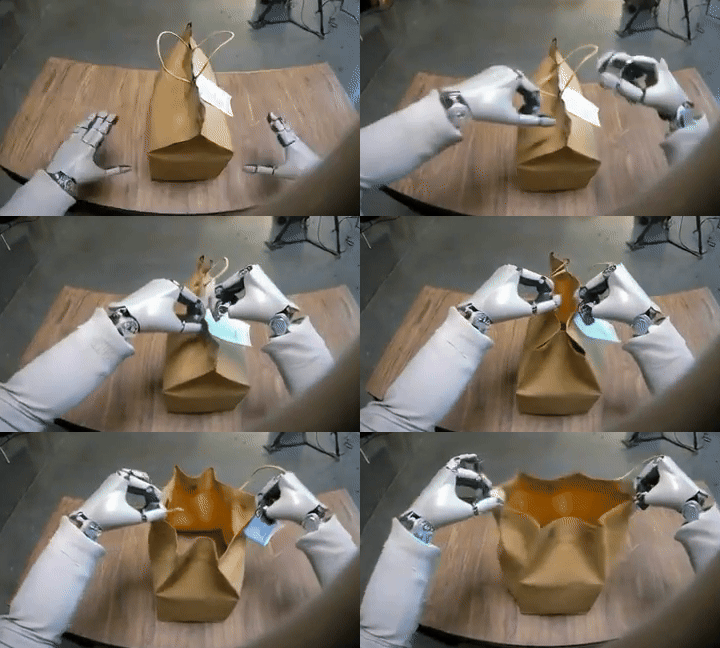
You can see this in a rollout of 1X’s world model — before the hand
even touches the bag, the handles start moving towards the hand. The
model does not understand physics, but it does understand that the
handle will almost certainly end up in the hand’s grasp and that it
should gin up a way for it to get there.
A first-person rollout of the 1X world model opening a bag. Note how the
handles jump into the hands of the robot before the robot touches the
bag. Source:
1X’s
world model demo (Two-Handed).
I do not think this is easily solvable by intentionally collecting a
small amount of failure data; █████ put
months of collection effort into accumulating these failure examples to
train its model, and the effort did not improve performance. Similarly,
██████ recently shut down its “video
model as a world model” effort and moved many of its researchers into
████████████ for similar reasons.
RL in a Traditional Sim
Traditional sim ensures that we have a causal model of physics
(assuming it’s programmed correctly), but it presents a number of
challenges of its own:
contact modeling (e.g., hard vs. spring contacts)
object modeling (e.g., soft- and hard-body modeling)
visual fidelity
environment engineering
speed
These tradeoffs are what caused the sim-to-real gap — policies
trained in sim perform perfectly and fail badly when run on real robots.
Enormous human effort has gone into engineering simulators, policy
representations, and rewards in order to get visionless[27] (or vision-lite[28]) policies to perform legged walking
and acrobatics, but visuomotor policies transferred directly from sim to
real appear to be beyond reach.
Importantly, progress on traditional sim historically depended
entirely on human effort and ingenuity (humans had to tweak the
code, design the environment, etc.), while the other two approaches
(learning in the real world and learning in a learned sim) were
learning-based and felt more scalable. Traditional Sim was very
anti-Bitter Lesson.
The Bull Case for Traditional
Sim
Traditional Sim is no longer anti-Bitter Lesson; we now have
superhuman coding agent swarms that can prove novel math results, and it
stands to reason that a swarm of coding agents ought to be able to
autonomously improve the sim codebase to address the above issues
without requiring human labor for every tweak and improvement.
The details of this still need to be worked out, and perhaps the
agents need slightly better physical intuition first, but given their
breakneck progress and ability to do 3D modeling, I suspect this is
coming soon, if it isn’t already happening internally3.
Perhaps they will need access to a real-world test environment to get
the details right, or perhaps large-scale real-world demonstrations
alone are enough, but I expect the agents to be able to close the gap in
visual fidelity, physical realism, etc.
Similarly, I expect stronger pretraining will also make policies
inherently more resistant to the sim-to-real gap. Early evidence
indicates that stronger base policies trained on both sim and real data
reduce the sim-to-real gap when trained in sim and transferred to the
real world[29,30].
Conclusions and Takeaways
This is phenomenal news for the general public. We are surely going
to have commoditized, high-quality robot models available in the next
few years, and that is going to power a Cambrian explosion of
intelligent physical systems everywhere. Americans are going to have a
strong, flexible, cheap domestic industrial base, access to cheaper,
higher-quality goods and services, access to white-glove eldercare, and
cheap, highly effective L4 autonomous driving offerings.
The title of this post was a riff on Francis Fukuyama’s 1992 book The
End of History and the Last Man. In some sense, I too am
predicting the End of History — we scale up VLMs4,
figure out how to RL them, and ride off into the sunset. Plenty of other
challenges remain, but by that point, it’s likely that RSI will handle
the computer-only issues, and the frontier challenges that require
humans will be far more focused on physical-world engineering and
operations. I’ve had the sense that robotics researchers have a shelf
life for a while. However, it was only with the recent generation of
frontier models that I could see the throughline to the End of
History.
Aren’t
Frontier VLMs too slow to perform reactive tasks?
Waymo trains large offline models too big and slow to run on the car
and then distills them down into smaller models that fit on the car.
We’ve seen progress in this vein in LLMs; 8-billion-parameter models
have become significantly better over the last few years in large part
due to the ability to distill them from stronger teacher models.
Distillation, combined with strong inference accelerators, will likely
eliminate this concern.
Who’s gonna win the model
race?
I don’t know. While there’s a clear leader in general capabilities5, we’re in the very early innings and
it’s too early to call. In the fullness of time, there won’t be a
monopoly winner.
References
[1] Claude Shannon. A Mathematical Theory of Communication.
1948. [pdf]
Section 3 describes generating English one letter or word at a time.
[2] Jeffrey Elman. Finding Structure in Time. 1990. [pdf]
Pages 196–197 describe training a recurrent network to predict the next
word.
[3] Sepp Hochreiter, Jürgen Schmidhuber. Long Short-Term
Memory. 1997. [pdf]
[4] Martin Sundermeyer, Ralf Schlüter, Hermann Ney. LSTM Neural
Networks for Language Modeling. 2012. [pdf]
[5] Dzmitry Bahdanau, Kyunghyun Cho, Yoshua Bengio. Neural Machine
Translation by Jointly Learning to Align and Translate. 2014. [pdf] For each word it
generated, the decoder learned how much weight to give each source
position.
[6] Ashish Vaswani, Noam Shazeer, Niki Parmar, Jakob Uszkoreit, Llion
Jones, Aidan N. Gomez, Lukasz Kaiser, Illia Polosukhin. Attention Is
All You Need. 2017. [pdf]
[7] Alec Radford, Jeffrey Wu, Rewon Child, David Luan, Dario Amodei,
Ilya Sutskever. Language Models are Unsupervised Multitask
Learners. 2019. [pdf]
[8] Tom B. Brown et al. Language Models are Few-Shot Learners.
2020. [pdf] Sections
2.1–2.2.
[9] Shaden Smith et al. Using DeepSpeed and Megatron to Train
Megatron-Turing NLG 530B, A Large-Scale Generative Language Model.
2022. [pdf]
[10] Nan Du et al. GLaM: Efficient Scaling of Language Models with
Mixture-of-Experts. 2021. [pdf]
[11] Aakanksha Chowdhery et al. PaLM: Scaling Language Modeling with
Pathways. 2022. [pdf]
[12] Kyle Vedder. Cargo Cults, Data Flywheels, and Novelty
Pumps. 2026. [website]
[13] Ilya Sutskever. NeurIPS 2024 Test of Time talk. 2024. [video] Sutskever
said that “data is the fossil fuel of AI.”
[15] Colin Raffel, Noam Shazeer, Adam Roberts, Katherine Lee, Sharan
Narang, Michael Matena, Yanqi Zhou, Wei Li, Peter J. Liu. Exploring
the Limits of Transfer Learning with a Unified Text-to-Text
Transformer. 2020. [pdf]
Section 2.2 and Table 8. The 6.1 TB figure refers to the
English-language baseline from the April 2019 Common Crawl snapshot.
[16] Leo Gao et al. The Pile: An 800GB Dataset of Diverse Text for
Language Modeling. 2020. [pdf]
[17] Jason Wei, Maarten Bosma, Vincent Y. Zhao, Kelvin Guu, Adams Wei
Yu, Brian Lester, Nan Du, Andrew M. Dai, Quoc V. Le. Finetuned
Language Models Are Zero-Shot Learners. 2021. [pdf] Fine-tuning with
natural-language instructions for more than 60 tasks.
[18] Ronen Eldan, Yuanzhi Li. TinyStories: How Small Can Language
Models Be and Still Speak Coherent English?. 2023. [pdf] Training small models
on synthetic children’s stories.
[19] Erik Nijkamp, Bo Pang, Hiroaki Hayashi, Lifu Tu, Huan Wang, Yingbo
Zhou, Silvio Savarese, Caiming Xiong. CodeGen: An Open Large
Language Model for Code with Multi-Turn Program Synthesis. 2022. [pdf] Successive training on
the Pile, multilingual code, and Python.
[20] Eric Zelikman, Yuhuai Wu, Jesse Mu, Noah D. Goodman. STaR:
Bootstrapping Reasoning With Reasoning. 2022. [pdf] Fine-tuning with
model-generated rationales that lead to correct answers.
[21] Pim de Haan, Dinesh Jayaraman, Sergey Levine. Causal Confusion
in Imitation Learning. 2019. [pdf]
[22] Pedro A. Ortega et al. Shaking the Foundations: Delusions in
Sequence Models for Interaction and Control. 2021. [pdf]
[23] DeepSeek-AI. DeepSeek-R1: Incentivizing Reasoning Capability in
LLMs via Reinforcement Learning. 2025. [pdf]
[24] Zichen Liu, Changyu Chen, Wenjun Li, Penghui Qi, Tianyu Pang, Chao
Du, Wee Sun Lee, Min Lin. Understanding R1-Zero-Like Training: A
Critical Perspective. 2025. [pdf]
[25] AJ, Dylan Patel. RL Environments and RL for Science: Data
Foundries and Multi-Agent Architectures. 2026. [website]
SemiAnalysis reports increasing RL compute at frontier labs and gives
lab-specific estimates. An industry-wide majority is unverified.
[26] Achu Menon, Sravanthi Machcha, Sabrina Zou, Tzu Kit Chan, Jay
Chooi. GPT-6 Astra on Robotic Manipulation. 2026. [website]
[27] Jie Tan, Tingnan Zhang, Erwin Coumans, Atil Iscen, Yunfei Bai,
Danijar Hafner, Steven Bohez, Vincent Vanhoucke. Sim-to-Real:
Learning Agile Locomotion For Quadruped Robots. 2018. [pdf]
[28] Takahiro Miki, Joonho Lee, Jemin Hwangbo, Lorenz Wellhausen,
Vladlen Koltun, Marco Hutter. Learning robust perceptive locomotion
for quadrupedal robots in the wild. 2022. [pdf]
[29] Marcel Torne, Anthony Simeonov, Zechu Li, April Chan, Tao Chen,
Abhishek Gupta, Pulkit Agrawal. Reconciling Reality through
Simulation: A Real-to-Sim-to-Real Approach for Robust Manipulation.
2024. [pdf]
[30] Abhiram Maddukuri et al. Sim-and-Real Co-Training: A Simple
Recipe for Vision-Based Robotic Manipulation. 2025. [pdf]
Don’t let the videogen backbone people trick you. Almost
all YouTube videos are just of people talking and are useless for
robotics model training.↩︎
SSI and Flapping Airplanes were founded on the premise
of searching for new, more sample-efficient learning approaches.
Flapping Airplanes has since pivoted to inference monokernels.↩︎
The Gemini team discussed transferring cornhole from sim
to real on an Apptronik robot in this
blog post.↩︎
I do not think the distinction between VLMs and video
models matters, and in due time they will all merge (e.g., Gemini Omni).
Unfortunately, many of the people stressing this difference are doing so
for strictly self-serving reasons, and reasonable
people have pushed back on this (3:21:01).↩︎
 is a mapping from a state
 to an action
 , written
 . We want to improve
 contains the system and task
prompts, as well as the state of the simulator, such as a PDF on disk
that contains a textbook on this topic of math, which the model needs to
read. The LLM policy
 predicts an action
 (a token), and that token is then added to its
context inside
 ; the policy then uses
 to generate
 , and this process repeats
until it hits its token limit or closes its answer block.
 and visited states
 , RL’s job is to decide how to update
 in a
successful rollout and equally punishing every action
 in an unsuccessful rollout will, in expectation,
lead to good actions (and good strategies) being upweighted and bad
actions (and strategies) being downweighted. These mixed-success
rollouts are then bundled together in a batch to compute batch
advantage (how good strategies are relative to each other) in order
to compute the needed update for
 that can meaningfully improve
 , and then
 from demonstrations that provide
 . There is a strong bias in the data distribution
for this objective.